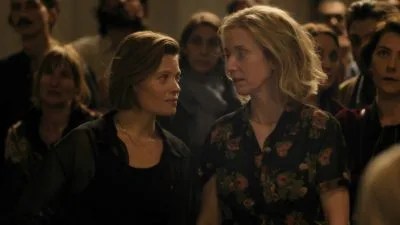
A Woman’s Life (La vie d’une femme) from Charline Bourgeois-Tacquet on the Femmes First strand of this year’s French Film Festival does exactly what it says on the tin.
On a black screen with pink writing like lipstick on a mirror, the film’s eleven sections show the shifting life of 50 something surgeon Gabrielle, immaculately played by the seemingly infallible Léa Drucker.
Drucker’s character is a woman who decided not to have children, although is stepmother to the now teenage children of her loyal partner Henri (Charles Berling), the tensions around which seem to affect her more than the full on phrenetic life she has in hospital. She is approached by the young writer Frida (Mélanie Thierry) to observe her at her work for a book and it is this woman’s entry in to her life that is a catalyst to change. Over the film’s narrative, Frida quietly makes her presence felt. She unsettles Gabrielle enough to make her take her texts during an important meeting with her team of surgeons who nevertheless remains focussed enough to upbraid trainees. On arriving home, she is met with a giant bouquet from Frida that positively dwarfs the bunch brought by Henri. Gabrielle is intrigued but still not hooked.
Running alongside her demanding profession and the shift in her relationship with Henri is her 84-year-old mother’s Alzheimer diagnosis where Gabrielle unblinkingly takes on the role of guardian with all that that role entails. Bourgeois-Tacquet waits till now to reveal Gabrielle’s attitude to parenthood when her belovèd colleague Kamyar Nazari (Laurent Capelluto) takes paternity leave and she reveals her early experience of being responsible for siblings saying, “I am not a victim of my choices or my gender.”
It is a hiking trip with Frida to a remote bothy in the Italian Alps, where her frantic life must seem like a world away and a kind of peace envelops her, that finally triggers the lesbian affair.
When her long-term friend and colleague Kamyar takes a post in a private hospital her sense of betrayal is palpable. This straw is the one that has broken her although the film subtly shows that her intense feeling for him was not mutual. Yet despite her anger at this perceived betrayal, she says naïvely to Frida at the height of their passion “This could never end.” Well, further shocks await Gabrielle before this series of snapshots of a particular woman’s life ends. Just as they do for us all.
Drucker’s performance is as ever simply remarkable as we witness the gamut of dramas in this woman’s life played out so convincingly but it is her restrained reaction when she is blindsided by Frida in Turin that seals her acting reputation. Watching her navigate her way through not just her character’s daily intense life or death pressures, but reconciling other elements in her life, makes this feminine film a real and satisfying experience.
Running time: 98 mins
Cert: 15
Scottish screening: Edinburgh Filmhouse on 30th November at 20.30
Irene Brown

