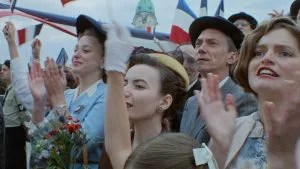
Director and writer Emmanuel Marre brings a story based on a series of letters between his great grandparents, Henri and Paulette Marre, during World War 2 in France. But this is no romantic tale. Instead through the character of Henri, exquisitely played by Swann Arlaud, we are offered an insight into the internal workings of the rarely exposed world of those Frenchmen who opted to support Marshal Pétain’s Vichy government after the German occupation.
Henri is the author of a book that gives the film its French title, Notre Salut (Our Salvation) that contains his vision for France as it turns from la République to l’État. He not a radical but a practical man so his seeking a job with the current collaborative power is no surprise. As another character says, “…better a kick in the arse than a bullet in the head.”
The opening scene at a party shows Henri’s social awkwardness with a lost, detached look that signals his remoteness from his family across the film. His detachment from personal matters is evident throughout and made emblematic later in the film as he pays a visit to a private tailor while telling his family to ‘tighten their belts’ after Paulette telling him she is finding it hard to manage. A bizarre and incongruous dance scene towards the end of the film adds nothing except confirming Henri’s lack of social skills.
Using appropriate 40watt lighting that also stands as a metaphor for the dark times the film is set in, along with accurate costumes some of which are clearly vintage, the period has been fabulously realised.
Marre has imagined the mainly separate lives of Henri and Paulette from 1940 till the allies’ landing in Normandy in 1944 (an event sadly accredited to the US alone in the subtitles) when Henri has managed to get a job working for the Vichy government in Limoges. While never quite managing to reach the higher level that he covets, he remains loyal to Pétain.
Voiced snatches of the inspiring letters feature across this insightful film as the serious reality of capitulation with Nazi ideals unfolds as when accounting is put before humanity when an employee to his cost attempts the small humane act of buying straw and chamber pots for Jews being transported.
Methods of manipulation, coercion and control used to prepare for a visit by Pétain is chillingly confirmed by real footage of such a visit giving a further insight into the absorption of the occupiers’ ideals. Henri’s underlying desire to rebuild France shows that there are varying ideas on how to achieve the common good. However, the imbalance of the relationship revealed between him and his family, and particularly between him and his loyal, loving wife, weighted against his opportunistic focus on his career is more difficult to reconcile.
Scottish screenings:
Edinburgh Filmhouse 28th November at 14.15
Glasgow Film Theatre 30th November at 19.40
Running time:158 mins
Irene Brown

