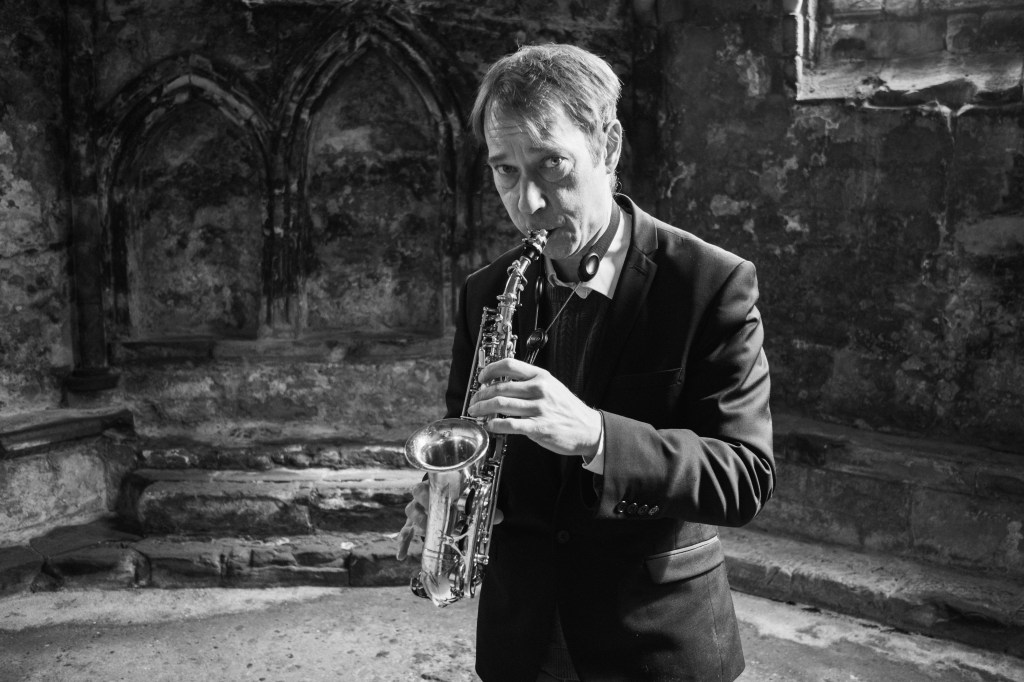
Multi-instrumentalist Fraser Fifield completes his stint as the University of Edinburgh’s Traditional Artist in Residence with a concert at the Reid Hall, Edinburgh on Thursday 18th June. The concert will feature the music he has recorded for his latest album, The Inchcolm Antiphoner.
The Inchcolm Antiphoner is Scotland’s oldest known musical manuscript. It is thought to have been composed or compiled around 1340 for performance as part of a religious service held in Inchcolm Abbey on Inchcolm Island in the Firth of Forth.
Fifield was introduced to the manuscript by Dr Neill Martin, the Head of Celtic and Scottish Studies at the University of Edinburgh, where the manuscript is held and where Fifield became Traditional Artist in Residence in 2022.
Previously, as part of this role, Fifield has recorded an internationally acclaimed trilogy of albums in a variety of musical styles and featuring his virtuosity on the low whistle. The Inchcolm Antiphoner sees him return to the soprano saxophone in a quartet with three of Scotland’s leading saxophonists, Sue McKenzie (alto) Martin Kershaw (tenor) and Allon Beauvoisin (baritone). It’s set for release on 31st July.
“The twenty-three songs and chants in the collection were written to be sung without accompaniment, and I chose the saxophone as it’s an instrument that has a very vocal quality,” says Fifield, who began his musical career on the Highland bagpipes before incorporating the skills and phrasing associated with the pipes in his playing of saxophone, whistles and other wind instruments. “I like the idea of the saxophone quartet as a kind of choir and as the music was composed before harmony was invented, it was interesting to arrange it for these four instruments with their differing ranges.”
The Inchcolm Antiphoner has been recorded before, most notably by Cappella Nova, Scotland’s leading vocal consort, and hearing these voices as well as looking at the manuscript with very its different notation style compared to today’s, inspired Fifield to set it for four saxophones.
“I was also fascinated by Inchcolm itself,” he says. “It’s a very atmospheric place, although the lifestyle of the monks in its abbey was very spartan, and as an improvising musician I found the discipline in keeping to the written notes a very different experience. I learned a few things and enjoyed the challenge. I spent a lot of time ensuring that the parts worked for everyone and there was consistency in the quality of the music. I’m looking forward to playing it at the Reid Hall, a fine setting with a lovely acoustic.”
Adam Roberts

