French Film Festival 2025
A 21st century photo shoot in Musée de l’Orangerie, where Monet’s water lilies paintings serve as a backdrop to a model’s poses and tourist selfies, perfectly sets the tone to this beautifully layered film from director Cédric Klapisch.
An old house in rural Normandy owned by a woman called Adèle Meunier and unoccupied since September 1944, when the area suffered badly from WW2 bombings, is in the way of a property developer with parking lots and a supermarket in mind. The relatives of Madame Meunier have been tracked down to decide what should happen to their ancestor’s assets. From these, 4 distant and disparate cousins who have been unknown to each other till the genealogist’s research brought them together with the rest of the remaining relatives, are tasked with going through the photos and artefacts, make an inventory to help the wider family make a decision.
What follows is a sweet unravelling of past lives that link these strangers. Klapisch achieves this through clever cinematography that interweaves the present-day characters, Seb (Abraham Wapler), Abdelkrim (Zinedine Soualem), Celine (Julia Piaton) and Guy (Vincent Macaigne) with their predecessors as well as highlighting parallels between them.
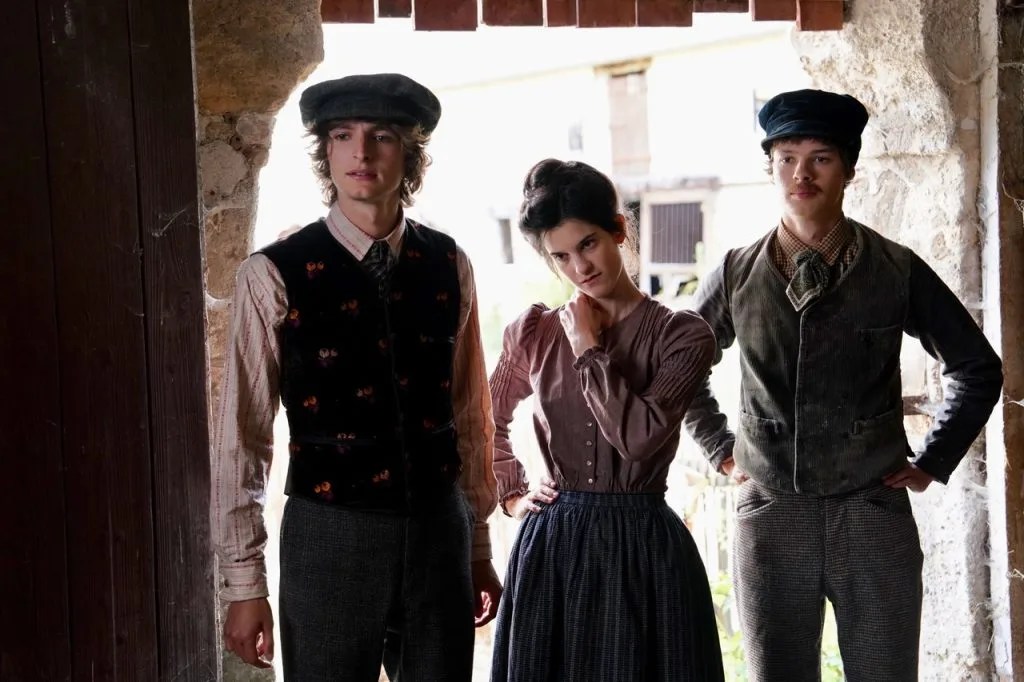
With beautiful shots of Normandy under its big skies, Adèle Meunier (Suzanne Lindon) leaves her boyfriend Gaspard (Valentin Campagne) in Saint-Jouin Bruneval to go to Paris to find her mother Odette Vermillard (Sara Gireaudeau) who had abandoned her to the care of her grandmother when she was only 1 year old. On her journey by boat down the Seine, where she meets 2 young men, aspiring painter Anatole (Paul Kirche) and Lucien (Vassilli Schneider) an equally aspiring photographer, who has a well-connected uncle in the city. We share these ingenues’ first glorious sights of Paris that manages to transpose their wide-eyed awe of the now iconic scenes to the viewer. Klapisch splices the variance in travel modes through smart shots of the four cousins arriving at relative speed at Gare St Lazare, recalled later by Emmanuelle Bougarol in her fine rendition of Aristide Bruant’s song of that name – á St Lazare.
The debate around painting versus photography is a constant thread through the film as we witness the Meunier ancestors on Zoom and fin de siècle photographers telling their subjects not to move while curators at le Havre’s MuMa are brought in to use modern detective skills on a found painting that helps to unravel the Meunier mystery.
While the scenes of a hallucinogenic experience may stretch the bounds of belief, it allows the characters to imaginatively interact with French artistic figures of what was a significant time in French artistic history.
La Venue de l’Avenir is both light-hearted and innocent carrying its French tropes without being schmaltzy. It is as visually delightful as the window of a French patisserie and whose ending comes together with the satisfaction of the completion of a gorgeous jigsaw.
Edinburgh screening: Filmhouse on 21st November 2025 @ 20.30
Irene Brown
 Radio Summerhall Arts