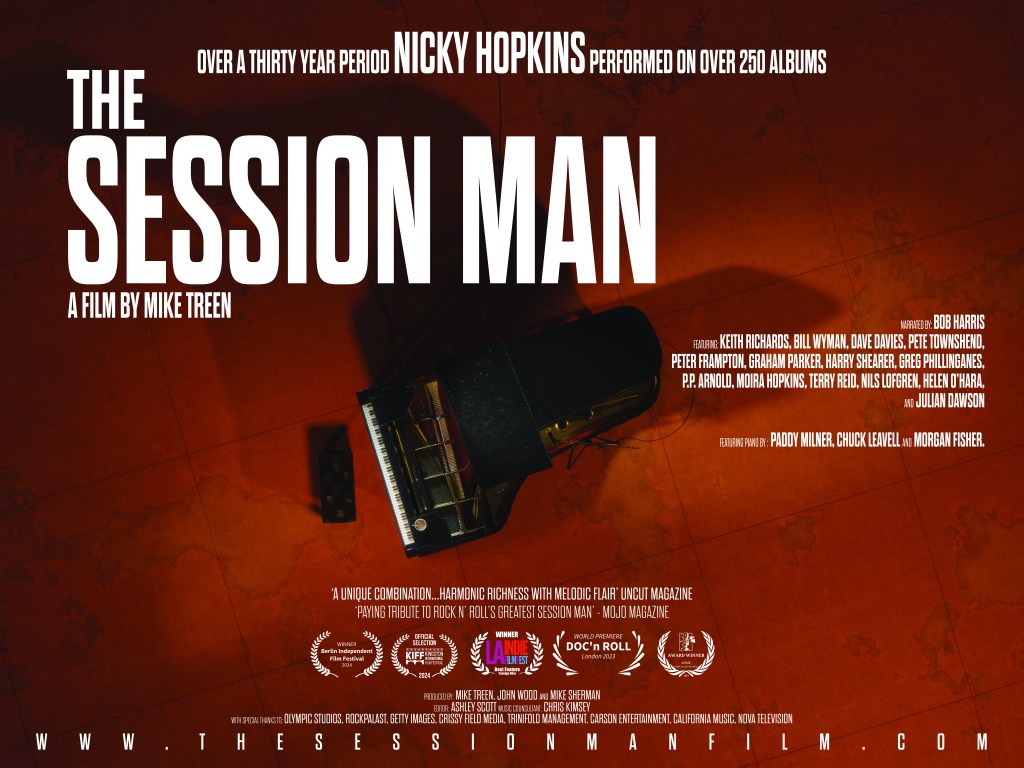
Dir Michael Treen
Nicky Hopkins could lay claim to being one of the greatest rock musicians of all time. His playing graced over 250 albums, enhancing work by the Rolling Stones, the Who, the Kinks, Joe Cocker and each of the Beatles. He toured with the Stones and Art Garfunkel among others and as well as being one of the most respected musicians of his time he seems to have been well liked by everyone he played with.
This 90-minute documentary covers Hopkins career from his emergence in the early sixties through to his untimely death at the age of 50. Having suffered from Crohn’s Disease throughout his life, embracing the excesses of the rock ‘n’ roll lifestyle, including addiction to heroin, sadly proved to be more than his body could handle.
His reputation as a likeable, charming man shines through in the interview clips here, but his natural setting of self-effacement leads him to understate his achievements. Fortunately, Michael Treen addresses this with some heavyweights of the rock world singing his praises. Mick Jagger, Keith Richards, Bill Wyman, Jim Keltner, Chuck Leavell and Jorma Kaukonen are just a few of those to enthuse about just how much he improved any session he worked on.
Leavell is among those who demonstrate what and how he played things that often might not be noticed until you take them out of the arrangements. And that leads us to the unfortunate flaw here – while we hear from Nicky in interview, there is next to no musical contribution from him. And for a film dedicated to his achievements, this is unfortunate to say the least. I imagine that this stems from the fact that he spent the majority of his career as a sideman, and so the producers would have had to shell out a considerable sum in royalties to those who hold the rights to the tracks on which he played. A sum that no doubt would have been way beyond their budget.
If you come to this film knowing who Nicky Hopkins was, it maybe won’t matter too much, you can do what I’m going to do as soon as I’ve finished this – dig out a few of the albums I have that he played on. But if you didn’t know him before and are intrigued by what you’ve learned of him it could be somewhat frustrating.
Still, it’s a film that deserves to be seen. It honours his memory and reminds those of us who heard him play just how good he was, while hopefully inspiring those to whom he is new to seek out some of his recorded work. He was, in the words of the old song, a man you don’t meet every day.
In cinemas from 21st November
Jim Welsh
 Radio Summerhall Arts