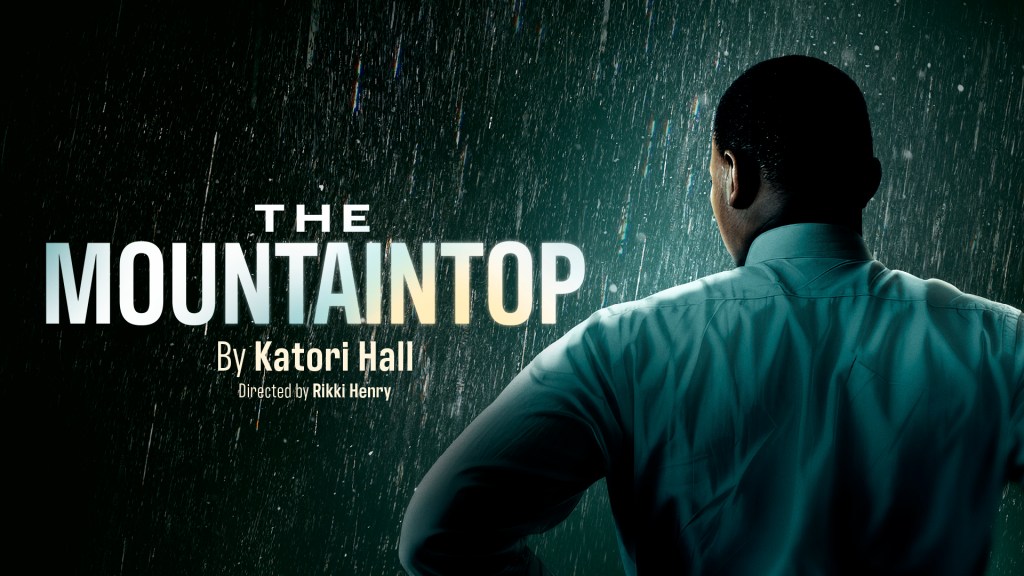
Before a word of Katori Hall’s play is spoken, a strong sense of subversion is already on stage. It is a stormy night on 4th April 1968, the setting is room 306 of the Lorraine Motel, Memphis and the guest is Dr. Martin Luther King Jr. (Caleb Roberts) who, just hours before, had delivered what was to be his last speech ‘I have been to the mountaintop’. In the room, whose disconcerting angles are only a hint of the greater metaphor created by designer Hyemi Shin, he stumbles around, hoarse and anxious, searching for hidden tapping devices. Frustrated at the time his fellow activist, Ralph Abernethy, is taking to get him cigarettes, he calls for room service for coffee to help him get on with writing his next speech.
The maid arrives in the form of Camae (Shannon Hayes) her bright uniform standing sharp against the set’s grey palette. In no time, the pair are flirting, sparring and sharing smokes, revealing King’s human flaws beyond just the holes in his socks. When hotel management fails to chivvy her on for being so long with one guest, it becomes clear she is a maid like no other. She may be young but she is straight talking, sassy and fearless and acts as a catalyst to King’s opening up about his fears and hopes as he may be sensing that he, a young man of just 39 years, is close to death.
Katori Hall’s script is woven with points of contemporary history and adeptly scattered humour that give a fine balance to this intense piece of theatre. The two characters express opposing ways of dealing with their struggle for civil rights. This man who says he was ‘just a preacher’ and wishes folk would listen to him ‘the way they listen to the Beatles’ is reminded by Camae that life is a relay race, not a solo marathon.
In an exposé of raw human emotions, the two characters express their catalogue of ideals and life’s paradoxes, while the set, like a strong 3rd character, shifts to an unsettling scene of the abysmal, manifesting King’s fears. As the veneer of this public figure is stripped away, he hallucinates while trying to buy time.
Under Rikki Henry’s impressive direction, Roberts and Hayes give strong performances commensurate with the weight of the play, where only the pillow fight near the end sits ill. Composer and sound designer Pippa Murphy’s merging of church organ notes into the soundscape is both sensitive and apt while Lewis Den Hertog video design visuals of prominent black figures across history to present day adds an impactful element to this already powerful piece of theatre that is a privilege to watch.
Irene Brown
 Radio Summerhall Arts