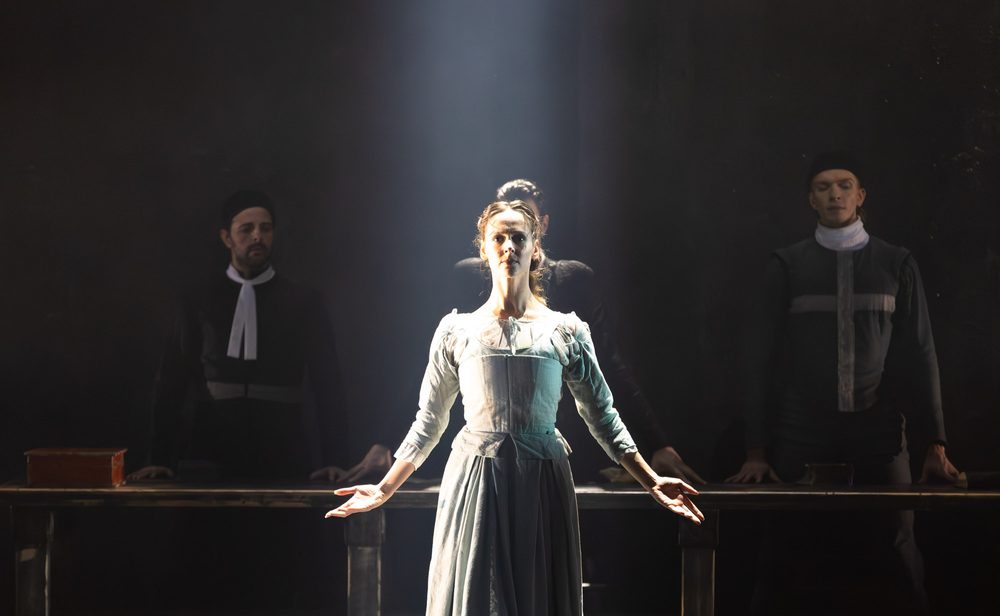
Scottish Ballet’s superb production of Helen Pickett’s multi-award winning adaptation of Arthur Miller’s The Crucible is on a Scottish tour, having recently enthralled audiences in Aberdeen and Edinburgh and is shortly to arrive in Glasgow.
Everything about this is outstanding; David Finn’s set and lighting combining with composer Peter Salem’s score to ominous, overbearing effect, Emma Kingsbury’s muted, Puritan costumes underlining the oppressive nature of the society ruled by the “men of God” who saw themselves as the moral superiors of their community – particularly, of course, to the womenfolk. And the choreography is brought to the stage by a uniformly excellent cast of dancers.
Bringing Miller’s text to the stage without a word being uttered requires a certain re-emphasis, which Pickett achieves by opening out the story, initially centering on the affair between seventeen-year-old housemaid Abigail (Kayla-Maree Tarantolo) and her employer, pillar of society John Proctor (Bruno Micchiardi), the discovery of which sets in motion the spurned Abigail’s desire for revenge.
In tandem with Abigail and her friends being discovered dancing, near naked and casting spells in the woods along with slave girl Tituba (Xolisweh Richards) by Reverend Parris (Andrea Azzari), this leads the girls to denounce Tituba and other women of the community as witches.
And so into the depth of the play. This production does a splendid job of making John Proctor as likeable and as human as possible, but it’s hard to sympathise with him, given he’s a married man who has just had an affair with a teenage girl and then dumped her to go back to his wife when the liaison is discovered.
The most outstanding performance comes from Jessica Fyfe as Proctor’s wife Elizabeth, her solo an emotional triumph that leaves a lasting impression.
As events run their course, Reverend Hale (Javier Andreu) a supposed expert in witchcraft is summoned. The witch trials start, the girls accuse more and more of the community, and Deputy Governor Danforth (Thomas Edwards) is brought to preside over the court.
The pointing fingers of the young girls become overshadowed by a torrent of mass hysteria that makes it not so much a trial as a demand for confessions to crimes the accused had not committed, their guilt or innocence no longer relevant.
A powerful play has become a powerful ballet that tells a story that, sadly, resonates today. But it makes for an unmissable, and unforgettable, night of theatre.
Jim Welsh
 Radio Summerhall Arts